



Australia’s recent decision to ban social media access for users under 16 marks a watershed moment in digital regulation. As the first country to enforce a nationwide age restriction on social platforms, Australia has forced governments, platforms, and technology providers to confront a difficult question:
How do you verify age online at scale, in real time, and without compromising privacy?
Traditional approaches such as self-declared birthdays, document uploads, or facial analysis have proven ineffective, invasive, or easy to bypass. To meet this new regulatory reality, platforms need a stronger, more trusted foundation for age assurance. That foundation already exists—inside the CSP/telco network.
Why Traditional Age Verification Falls Short
Most social media platforms rely on methods that were never designed for regulatory enforcement:
- Self-attested age can be easily falsified
- ID uploads introduce friction, privacy risk, and data liability
- Biometric or facial analysis raises serious ethical and regulatory concerns and is not infallible
- Device-only checks fail when devices are shared, reused or changed
As regulators increase penalties and enforcement, these approaches no longer provide sufficient assurance—or defensibility.
The Network Advantage: A New Trust Signal
Mobile networks already authenticate billions of users every day. Subscriber identity, SIM ownership, device relationships, and network behavior provide real-time, carrier-grade signals that are extremely difficult to fake.
This is where Network APIs, exposed through initiatives like GSMA Open Gateway, come into play.
Instead of asking users to prove who they are, platforms can ask the network to confirm what is already known—securely, privately, instantly, and with user consent.
Where Shabodi NetAware Operator Platform Fits In
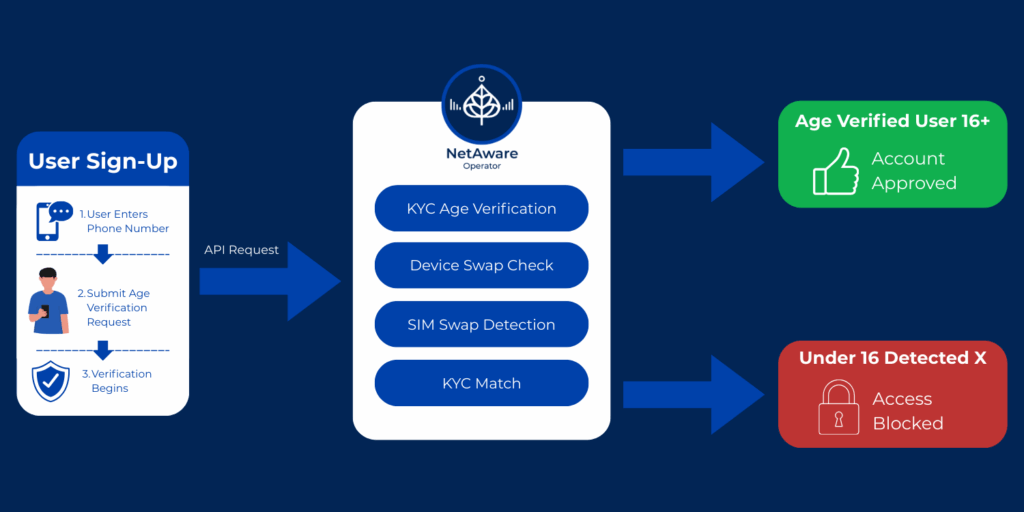
Shabodi NetAware turns telco network intelligence into enterprise-ready APIs that social media platforms can use to enforce age-based access with confidence.
Rather than replacing existing verification methods, NetAware enables a network-backed verification layer that dramatically strengthens age assurance while minimizing user friction.
Key NetAware Operator Platform Capabilities for Age Verification:
1. SIM and Device Integrity Checks
Using GSMA Open Gateway–certified APIs such as SIM Swap and Device Swap, platforms can detect:
- Recently changed SIMs or devices
- Suspicious account creation patterns
- Attempts to bypass age restrictions using borrowed or recycled hardware
This ensures the account is tied to a stable, legitimate subscriber identity.
2. Carrier Account Signals and KYC APIs
NetAware can surface privacy-preserving carrier insights, such as:
- Whether a line is associated with a family or adult account using APIs like KYC Match
- Subscriber status indicators that support age eligibility decisions, using API KYC Age Verification
- Additional key insights using APIs: KYC Tenure and Number Recycling
Critically, platforms can receive a simple “eligible / not eligible” response—without ever seeing a birthdate.
3. Real-Time, Risk-Based Decisions
By combining multiple network signals—SIM status, device history, roaming state—NetAware enables:
- Low-friction onboarding for legitimate users
- Step-up verification only when risk is detected
This keeps experiences smooth for compliant users while tightening controls where it matters.
4. Built-In Privacy and Compliance
NetAware APIs are designed to:
- Minimize data exposure
- Avoid storage of sensitive personal information
- Support compliance with privacy regulations and emerging age-assurance laws
The result is a defensible, auditable approach to age enforcement.
Why This Matters Now
Australia’s under-16 social media ban is unlikely to be the last. Regulators worldwide are closely watching, and similar requirements are already being debated in Europe, Asia, and North America, not only in social media but also in the online gaming industry.
Platforms that rely solely on legacy age checks face:
- Higher regulatory risk
- Increased fraud and circumvention
- Growing privacy liabilities
Network-aware verification offers a future-proof alternative.
The Bigger Picture: Networks as Trust Infrastructure
Age verification is just one example of a broader shift underway.
As digital regulation accelerates, networks are becoming programmable trust infrastructure—providing real-time, authoritative signals for identity, security, compliance, and monetization.
With Shabodi NetAware, enterprises, aggregators, and service providers can tap into this network intelligence through standardized APIs—turning regulatory pressure into an opportunity to improve security and user experience.
Final Thought
The question is no longer whether platforms need stronger age verification.
The question is how to do it without breaking privacy or usability, and how to scale.
If you are a Telecom Operator and looking to expose your network intelligence and signals, Checkout how Shabodi NetAware Operator Platform can help you.